Friday, October 21, 2011

Posting Assignment #5 (due Sunday 10/23, 11:59 P.M.; comment by 11:59 Monday, 10/24: Make History


Early in our work, we listened to Gang of Four ask 'Why theory?'  They sing 'We've all got opinions.  Where do they come from?'  This project asks us to explore where opinions come from—actually our whole views of the world—by examining bits of our personal and public histories.  Where, exactly DID some of our 'opinions' come from?

Robin does his homework: Mom put this picture in my babybook on the page for 'Baby's Fourth Birthday.' Apparently I didn't have a good time because I was worried that the other kids' balloons would break and they wouldn't have a good time.  From the left: Guy Huntley, Phillip Moreland, Donny Peterson, and me (what was Mom thinking with the flowered matching outfit?).  Guy became an insurance salesman. Phillip (the goofy looking one) became a Catholic priest.  Donny's father was a coal miner, and Donny followed him into the mines.  He died there in an explosion (Consolidated Coal) at 52. And me—well, you know me.  Somehow—even at four—we all knew that Donny was a 'working class kid' (though we didn't have the words for it).  The other three of us were supposed to do better in school (and we did). It's almost a GRAND NARRATIVE of what a good boy does with his life.  But I always thought Donny was smarter than the other two.  He knew how to wire up the electric trains.  He could track animals.  He was a lot more fun.  Maybe biology matters (I still worry about whether the other kids will have a good time). But class really matters. Class determined a lot of my history, and if I were writing this blogpost, I'd take that topic, and use this baby book and picture as my 'historical archive.'

Write a tiny mini-history in which you show how particular events, people, forces, spaces, objects and so on have contributed to your 'story' of who you are.  Remember that we're suspicious of Grand Narratives, and that we know that every story will be shot through with ideology—can't not be. In fact, it' this critical look at the 'stories' that ordered our lives that can be the most interesting part of this project. Got images?  Put 'em in. Find things that mattered (songs, movies, soccer, Girl Scouts, school, 4H)? Talk about it. Is it important who you (the writer) are, too?  Talk about that.  Need models?  Well, that's tough, because all of us are so different and so are our stories.  But no stupid Yearbook-ish generalities.  No pious 'moral lessons learned.'  Think Spiegelman—right, you maybe can't draw like him, but we can all try to THINK like him….

Look hard, talk with your family and friends, share your ideas with your group.  Show us how a life took shape, and how you shape the story.

Does this one need 'theory'?  Not so much, but it really does need to do our kind of work: to show us how big historical operations play out in our very intimate lives.

Sunday, October 16, 2011

Intel

This is an advertisement for Intel’s 2007 core 2 duo processor that says that it will “multiply computing performance, and maximize the power of your employees.” In this picture we have six African American male athletes bowing to their Caucasian employer in an office setting. My initial reaction upon seeing this advertisement was that I definitely cringed; I thought it was very odd that all of the men bowing were African American and they were bowing and appearing subservient.

This advertisement made me think of the days of slavery, the way that the African American men seemed beneath their Caucasian boss who’s standing proudly above his workers. I’m sure that it wasn’t the intent of the creators of this ad to offend anyone or even to subtly hint at the stereotype of the African Americans working for the White man, but the fact that it wasn’t even considered until it had already been released sends the statement that to all the people that had approved this ad subconsciously thought that there was nothing wrong with the way it was staged.

Mexican Drug Trade

http://www.nytimes.com/2011/10/16/world/americas/calderon-defends-militarized-response-to-mexicos-drug-war.html?_r=1

My apologies for the lack of picture but of course when I do the post this website has "internal errors" so I couldn't upload the picture.

The picture i'm referring to at that link is the very first image, with military looking men surrounding the dead bodies of supposed drug gang members. The troops in the background are just acting all non-chalant in the presence of the bodies. The caption reads that they killed the men in a shootout. It doesn't seem like much of a "shootout" to me when it's 4 of the gang members and at least 9 trained military personnel. That seems like more of a one-sided battle than anything. I'm not sticking up for the gang members by any means, but the way the media portrays the situation seems slanted.
You can read into the culture of the dead guys by the contents of their pockets laying in between their legs, aka signs. Wallet, bag of presumed drugs, cigarettes, joints. Their weapons are in plain sight, which I don't understand because you'd figure the troops would take the weapons away as soon as they were disarmed of the members. The article is about the President's involvement in making a higher resistance to drug cartels so it seems like he specifically went out and killed 4 on the spot so he could set up this propaganda to boost his own image. It's understandable for a fan boost but the concept of the situation is awful. Those gang members, granted most likely beginning the firing of the guns, had families and friends they were leaving behind. Over propaganda that seems a bit harsh.

The Black Brute

     Immediately when I saw these two pictures compared I knew it was a gold mine in the cultural studies field, as it depicts both racial and sexual stereotypes of African Americans and women. I was unfamiliar with the term 'black brute', so I decided to research its origin. I learned that this stereotype of African American men became popular in the reconstruction period after the American Civil War. The black brute term centralized on two themes, violence and sexuality.  African Americans were thought to be savage and violent, but it was believed that slavery had tamed them. After emancipation, whites feared their slaves would return to their supposed natural and 'primitive state'. They also feared the blending of the races because of their 'sexual powers' and their religious practices, such as hoodoo and voodoo. Black men were often larger and stronger than white men. They were viewed as 'hyper-sexual", as it was thought that slavery repressed their sexual desire. Women, especially white women, in this time period were viewed as the weaker sex, and the target of these black brutes. There were many lynchings of black men on the account of raping a white woman.
     And now for the painting on the left. It was painted in the year 1917 and used as an WW1 American recruitment poster. This gorilla is actually representing a German soldier, as he is wearing a distinctly German military helmet. The word Kultur, culture in German, is engraved in a bloody bat. This symbolizes their uncivilized actions in the Rape of Belgium, in which Germany terrorized Belgium, shooting thousands of civilians and destroying their country. It was thought to be the beginning of Nazi Europe. It is very interesting to me that American propaganda used what looks like a representation of a black brute to depict a German, as Germans are white. Educated people in this time period were probably aware of the connection of the barbaric Germans and the stereotype of black brutes. I also noticed that the city is destroyed in the background, which can be connected to how white men feared black men would destruct their cities. This poster compares the horrific actions of the German nation, to the old stereotypical qualities of black men.
     In 2008, American Vogue featured LeBron James and Gisele Bundchen on the cover, in a picture that very closely resembles this war poster. It makes me wonder if the black brute stereotype is still present in American culture today? And if so, instead of being a negative stereotype, is it possibly one that is idolized? These two stars are role models of many Americans today, and their bodies represent our culture perfectly; big, strong, athletic men, and small, beautiful, done-up women. It is so interesting how the times change, and how culture influences and shapes our docile bodies according to its present ideals.

White Minority?


We live in a nation where the diversity is increasing at a modest rate. This photo of a white egg among many brown eggs represent that an idea that the white race is slowly becoming the minority. Many people along as I find this true, but only at a regional level. Urban area's, see an alarmingly high minority to white ratio, but it is a sub-culture that is associated with this statement, where it may be true that there are more minorities than whites in urban areas, but it's probably more accurate to say that the lower class will live near the city. This photo not only embraces the idea that the white race is becoming more of a minority but also, less of a dominance. In many college's, the ratio of white to minority is increasing. In today's college life, one may see a lot more white skinned people than one of color, but 5-10 years ago, would one see the same amount of color people as one does today? Although the statistics show that the majority in, lets say the twin cities, are those of color, the data is misleading. As I grew up in the suburbs, the minority are those of color, but from past experiences, I hear many people in the suburbs say that they believe the white population in slowly becoming the minority based on the statistics of urban areas. I feel at times, that those statements are made in fear of the probability that white dominance is slowly decreasing, however it is just one experience from one town. Every year I did see the number of color students increase but not enough to suggest that white is still dominant. Politically this shows that minorities are of lower class because they make up the majority in the city, where as white families have the luxury of growing up in the suburbs where the yearly income his alarmingly higher than those in the city and can afford to commute every day. I do feel however that these statements are natural and fairly accurate, solely because the white culture has been here the longest and it has left a mark on the states where as many cultures of color have yet had the opportunity to leave it's mark considering how short of a period they have been here.

Voters in Liberia

Here in America we take voting for granted. The right to have a voice in your government is one that far too many people do not have. For the Liberians in this photograph this is only the second presidential election since the end of their civil war. For them, voting is a rare privilege that I'm sure they appreciate fully.

But for us Western (mostly white) people, these voters are matter out of place. To put my racist hat on: Africans don't vote. We vote. I think that the American reaction to this image is not that these people are gaining a voice and becoming empowered, it is that they are becoming more like us. It's true that some people really get into these issues and understand everything that is going on, but the average person will think "Oh, those 'others' are getting to vote, that's how we do it so that's good"

When I saw this picture I thought of all of the other pictures of "first elections" that I have seen. None of them are of the middle class voters in cities, they are of poor people with a poor looking background, in this case the ratty clothesline and the paint falling off the building. We don't care that the middle and upper class people are becoming more like us, they were already kind of like us. I'm sure that the photographer could have framed the picture in a way that had a much more flattering background, but that wouldn't have conveyed the same message

It is really hard to talk about this subject without sounding racist or overly-stereotyping, but I think that this way  that people view things like this is generally true. Does anyone disagree?

For we are the 99%

For those people who have no idea about the event yet (Kind of impossible), here is some brief introduction to this event from Wikipedia: Occupy Wall Street is an ongoing series of demonstrations in New York City based in Zuccoti Park, formerly "Liberty Plaza Park". The participants of the event are protesting against social and economic inequality, corporate greed and the influence of corporate money and lobbyists on government, among other concerns. By October 9, similar demonstrations had been held or were ongoing in 70 major cities and more than 600 communities.

The root of this movement is the financial crisis which has been impacted The whole America for more than three years. The worst part is that the Financial executives who ran the collapse of the institutions has yielded untold financial pain do not get the according punishment while still get High dividends from their products bought by ordinary people. That is just the 1% persons taking the other 99% peoples’ wealth.

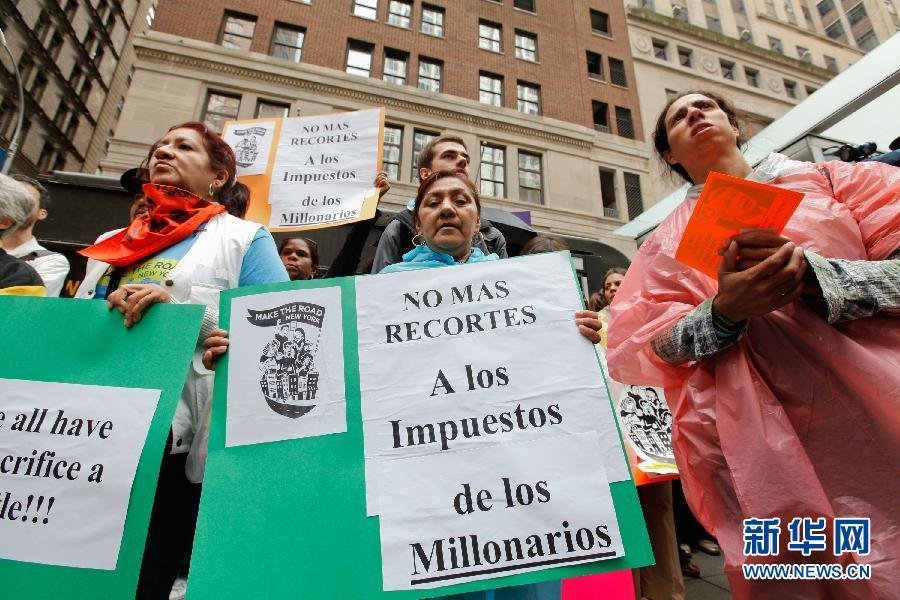
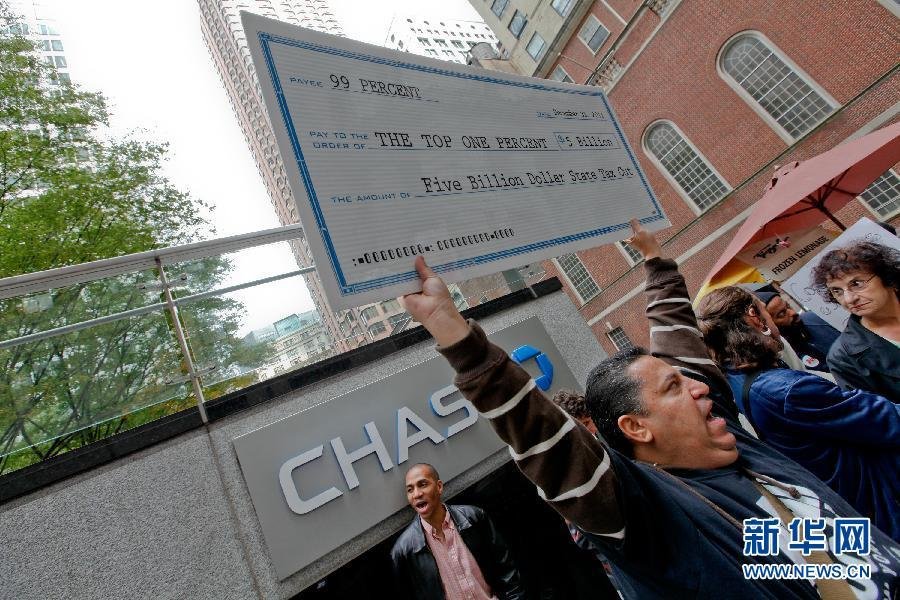
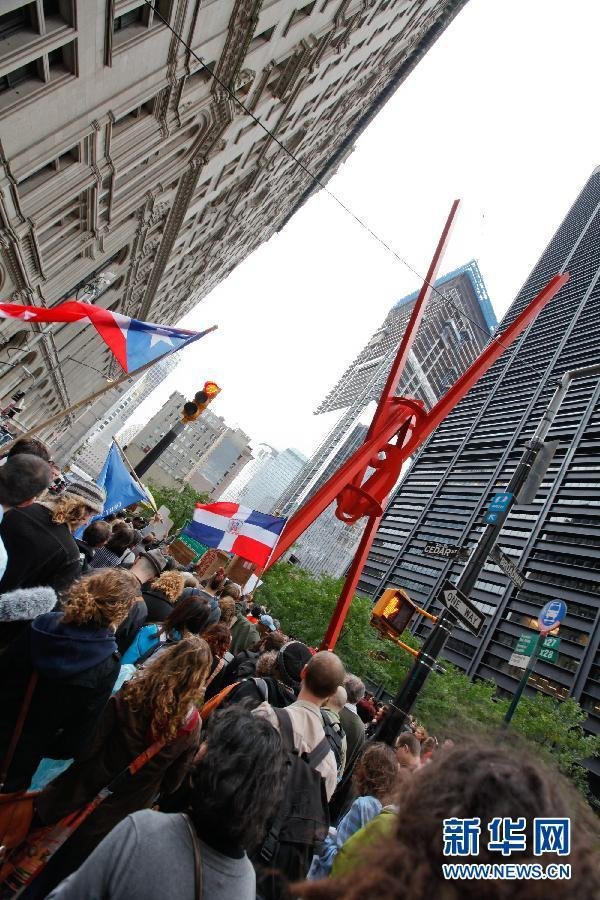
These pictures show directly the anger and the dissatisfaction of people from all over the world.:

Women are not considered as the weak who passively accept the result any more, they stand out for the half of the world as a portion of the 99%.

Language is not just a tool but a weapon to show that no matter what races we are, we are here as human beings pursuing for same rights and treats as a portion of the 99%.

Distance is not a block because of the globalization. We are experiencing the same situation now, no matter severe or mild. If the democracy still exists, the majority rules should work for that we are just the 99% of the world.

We never want something violent, like injury or death. But we never imagine that we are sacrificing ourselves by checks, which we use in our everyday life. Just like the picture shows, we paid with no benefits back as you promised, the 1% top "financial talents". Who do you think you are, running around leaving scars.

So here we are, as male and female, as the senior and the young, as black white or orient made. We do not hold the wish or the hope with us but the desire! The desire to make improvement, to get back what belongs to us, for we are the 99%.

As to the 1%, please take good care of your jar of hearts. Don't come back for me, don't come back at all! Who do you think you are!